
A khat seed is a dark brown grain of about 3 mm with a thin, papery wing attached, produced one to three at a time inside a small three-sided capsule. It does not keep well: botanical references agree that it loses its ability to germinate soon after it ripens.
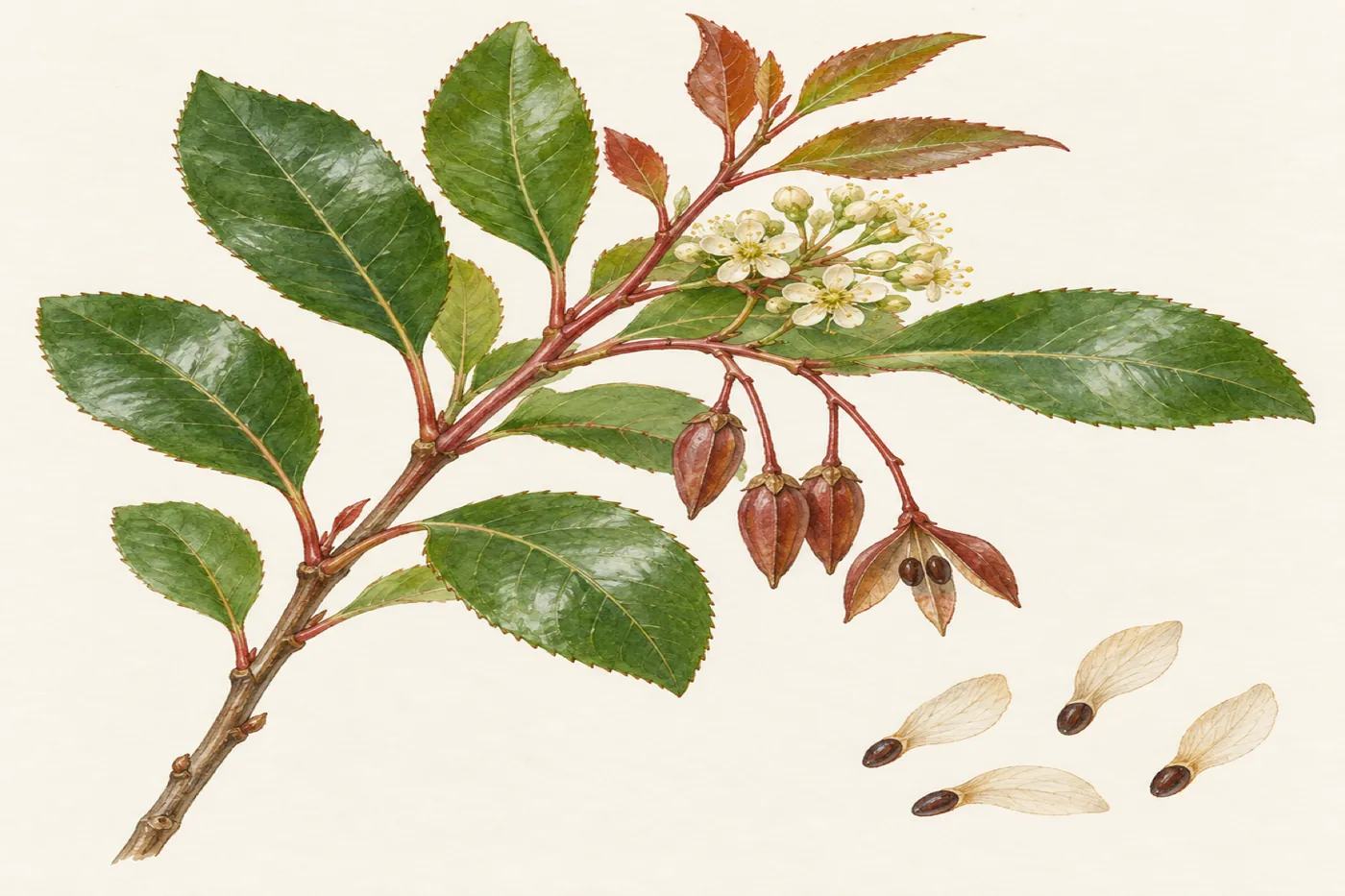
The capsule that holds the seed
Catha edulis flowers in clusters of tiny white or pale yellow flowers, 2 to 4 mm across, that sit in the angles between leaf and stem. In Ethiopia this happens during the rainy season, July to September, and the fruits are ripe within about four months of flowering (PROTA4U).
The fruit is a capsule: narrow, oblong, three-sided and hanging from the twig. It measures 6 to 12 mm and turns red to brown as it ripens. When it is ready it splits lengthwise into three valves. Most capsules hold one to three seeds. In South Africa the capsules appear from late October, and according to PlantZAfrica they split in late summer to release the seeds.
The seed and its wing
The seed itself is obovoid, a narrow egg shape with the broad end at the top, and flat on one side. PROTA gives its size as 3 to 3.5 mm long and about 1.5 mm wide. The seed coat is dark brown with a slightly rough, papillose surface.
Attached to it is a membranous wing of 5 to 5.5 mm by 2.5 to 3 mm, so the wing is longer than the seed it carries. Inside, the embryo has two long, thin seed leaves (cotyledons) and a small shoot tip, embedded in endosperm, the seed's stored food.
| Feature | Measurement | Source |
|---|---|---|
| Capsule length | 6 to 12 mm | PROTA4U |
| Seeds per capsule | usually 1 to 3 | PROTA4U |
| Seed size | 3 to 3.5 mm by 1.5 mm | PROTA4U |
| Wing size | 5 to 5.5 mm by 2.5 to 3 mm | PROTA4U |
| Seeds per kilogram | 60,000 to 80,000 | ICRAF Useful Trees, Uganda |
| Time to germinate when fresh | 15 to 20 days | PROTA4U |
A kilogram of seed holds roughly 60,000 to 80,000 seeds, according to the ICRAF tree guide for Uganda. That puts a single seed at around 12 to 17 milligrams, wing included.
A seed with a short shelf life
The most practical fact about khat seed is how fast it fades. PROTA puts it plainly: fresh seeds germinate within 15 to 20 days, and seeds soon lose viability. The ICRAF Agroforestree entry for Kenya advises sowing the seed as soon as it is ripe for the same reason. PlantZAfrica goes a step earlier and recommends collecting the seed just before the capsules split.
There is one dissenting note. The ICRAF guide for Ethiopia lists the seed under "can be stored", without saying for how long or under which conditions. No source we found gives storage temperatures, moisture contents or germination percentages after storage, so the honest summary is that khat seed is short-lived and that we found no published figure for how short.
This matters for anyone comparing a seed packet with the descriptions above. Seed that has been dried and kept for a long time may simply not come up, and that says nothing about whether it was genuine Catha edulis.
Why khat is rarely grown from seed
In the countries where khat is a crop, seed plays almost no role. PROTA notes that nearly all propagation is by cuttings taken from upright shoots, and that this is the reason so little has been published about seedlings. The ICRAF guides say the same: the usual route is root cuttings or suckers, though seedlings "can be raised too".
Farmers have good reasons for this. Cuttings give a copy of a plant whose leaves they already know, and khat growers in Ethiopia and Yemen keep named local forms that way, such as 'Dallota', 'Dimma' and 'Mohedella' in Ethiopia, or forms named after a place in Yemen (PROTA4U). A seedling is a genetic gamble, and the genus is described as a single, highly variable species.
Outside farming, seed is still used. Catha edulis grows naturally in evergreen mountain forest from Eritrea to the Eastern Cape, and in South Africa, where it is a native tree, gardeners raise it from seed in trays, as described on the germination page. How far the winged seed travels in the wild is not recorded; the ICRAF entry for Kenya lists its dispersal as unknown.
Seeds and the law
The seed is the one part of the plant that the Dutch and British definitions leave out. The Dutch Opium Act names "the leaves and twigs" of Catha edulis; UK law names "the leaves, stems or shoots". Neither mentions seed. Germany is different: its narcotics act also covers biological material suitable for reproduction, which includes seed, when it is intended for use as an intoxicant.
The catch in all three countries is what a seed turns into. A khat plant grows leaves and twigs, and growing it is prohibited or treated as production. The details, with dates and sources, are on the page about khat and the law.